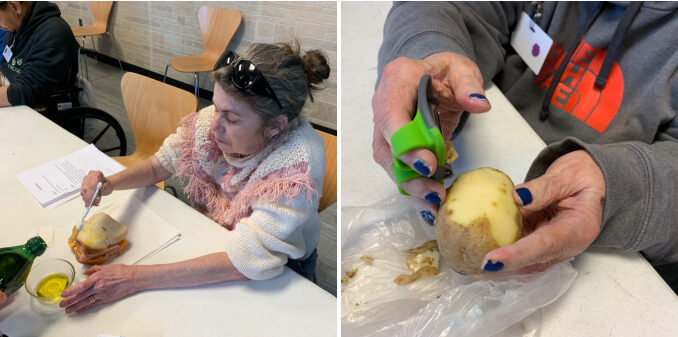
Local residents can now learn recipes from the safety of their homes and connect with others while social distancing. The Disability Network will be offering adaptive cooking classes online starting in December. Classes can be accessed by computer, tablet, or phone.
Led by The Disability Network’s newest team member, Amario Rice, these classes will introduce adaptive cooking tools and techniques that can help home chefs of all expertise in the kitchen.
Ingredient lists will be provided leading up to class sessions so participants can get them before classes begin.
This program is supported in part by the Community Foundation of Greater Flint. The grant allowed The Disability Network to acquire technology for a limited number of participants.
However, there are many more people in our community who could use a tablet, internet access to join this class, and many other virtual classes that will be offered in 2021.
Donations made to our recreational programming will help us pay for tablets, internet access, mobile plans, and materials for local seniors and individuals with disabilities living independently in the community.
With your support, TDN can acquire materials needed to keep people connected to our programs and to each other. Donations can be made using Paypal.
The Disability Network is launching a new temporary ramp program in response to COVID-19 funded by the Community Foundation of Greater Flint. These ramps will help people transition out of the hospital and back to their homes quickly. Ramps are often considered unfunded medical equipment, forcing people to figure out how to get themselves or family members home when mobility has changed significantly.
“Flint Hospitals are at 97% capacity. We need to reach people in hospitals right now during this third surge who need and want to get out immediately and would benefit from a temp ramp while they rehab.
In speaking with a local hospital about the ramps, [COVID patients] need them to get out of the hospitals now to clear space for the next patient. A lot of the recovered COVID patients are too weak to get upstairs which prevents them from being discharged. They will only need a ramp temporarily.”
Luke Zelley, CEO The Disability Network
Support Our Ramp Program
Other community ramp programs have waiting lists and take up to three months to build ADA and code-compliant ramps. Individuals need these quick temporary ramps to get them home to recover. Some require a temporary ramp while waiting for permanent solutions to avoid being sent to nursing facilities while they rehabilitate.
“A temporary ramp can provide quick access for people who face challenges getting in their front door. It’s especially helpful for people coming home from a hospital with additional medical issues. It’s one less thing to worry about. Funding these ramps can mean people get back into their homes in time for the holidays. You can be a part of their homecoming.”
Joel Feick, Director of Resource Development at The disability Network
This program is offered in part through the support of the Community Foundation of Greater Flint. Please consider a donation to our temporary ramp program to help us deliver more ramps to people in the community. The funds you give go directly to the cost of purchasing and installing these temporary ramps.
To donate to our ramp program, please click the button below. You will select Ramp Program from the drop-down on Paypal’s website. Link opens in a new window.
To learn more or make a donation to our temporary ramp program, please contact Joel, Resource Development Director, at joelf@disnetwork.org or 810-742-1800, ext 315.
Six individuals participated in The Disability Network’s fall art class held at the Flint Institute of Arts. Expressions Inclusive Art Class, which ended in late-October, gave students experience with oil pastels, pottery, and acrylic paints over four sessions.
The smaller class produced a number of pieces on canvas and with clay. The final project concluded with winter and holiday scenes painted with acrylics. The Disability Network plans to feature one of the artist’s works on their annual holiday card as they have in past years and is asking the community to vote on their favorite piece on Facebook.
This is the third year that The Disability Network has offered the accessible art classes at the Flint Institute of Arts and supported by Blick Art Materials. The classes are free and open to the public.
Originally scheduled for six sessions, the class ended earlier than scheduled due to rising public health concerns. Expressions is typically offered four times a year and is expected to run in January 2021 depending on the health and safety of the community. Masks and social distancing will be required. To learn more about Expressions Art Class, please contact Carrie Gerdeman or for more information about recreational therapy and independent living skills, contact Amario Rice at 810-742-1800.
Gallery of Expressions Inclusive Art Class Images
Exterior of the Flint Institute of Arts
Sculptures and bowls created in the class
A glazed sculpture of a creature
Bowls and sculptures after glaze
Artists paint with acrylics in the classroom
One of the students paints a snowman
Carrie Gerdeman leads Expressions Inclusive Art Class and Amario Rice, new recreational therapist at TDN, assists
We believe in a world where everyone is valued. We stand in solidarity with advocacy organizations across the country to condemn the murder of George Floyd in Minneapolis, end the hatred of racism and ensure equality for all people.
We grieve with a community whose pain, frustration, and anger has been ignored for too long. We are committed to fighting for justice and removing institutional discrimination for all marginalized populations until the day when everyone in our world is valued.
We are driven by our mission and values to advocate and drive change. To ensure we are meeting the promise of our mission and holding up a core belief: “Nothing about us without us,” we vow to take action immediately regarding representation on our leadership team and our board. Further, we will amplify voices at the intersection of Black, Indigenous and People of Color and disability activism, and continue providing bias training for local law enforcement.
It’s okay if you feel like you’re falling apart right now, tacos fall apart and we still love them!
If you’re feeling overwhelmed by all of the turbulent things happening in your own world or the world at large, please reach out – your mental health is a priority!
Below are resources to get you connected with some supports:
Mental Health America: https://screening.mhanational.org/content/need-talk-someone-warmlines Warmlines were created to give people support when they just need to talk to someone. Speaking to someone on these calls are typically free, confidential, and run by people who understand what it’s like to struggle with mental health problems.
Disability Network Oakland & Macomb is excited to host a 10-week virtual workshop on living well with a disability.
This 10-week workshop is designed for people with disabilities who want to learn new skills, meet new people and improve their quality of life by improving their health. Learning healthy lifestyle habits is possible and fun with the support of peers.
Participants in this workshop develop independent living skills such as goal setting, problem solving and communication skills and have the opportunity to practice them in a supportive peer environment.
10 Week Workshop Schedule
June 2nd: Setting Goals Goal Setting helps us consider our life values and identify a meaningful goal based on those values.
June 9th: Solving Problems Problem Solving helps us identify and address the obstacles we encounter in reaching our goals.
June 16th: Healthy Reactions to Frustration Healthy Reactions teaches us how to use our thoughts to reduce frustration when solving problems.
June 23rd: Beating the Blues Beating the Blues discusses ways to manage discouragement and avoid depression.
June 30th: Health Communication Healthy Communication focuses on ways to effectively communicate our needs to help us reach our goals.
July 7th: Seeking Information Information Seeking identifies ways to find resources that help remove obstacles on the path to reaching our goals.
July 14th: Physical Activity Physical Activity highlights the health benefits of increased physical activity and how it builds the strength and endurance we need to pursue our goals.
July 21st: Eating Well Nutrition focuses on eating a balanced diet for increased energy and stamina to pursue goals.
July 28th: Advocacy Advocacy addresses self and systems-based ways to change our communities so we can solve problems and attain goals.
August 3rd: Maintenance – New You Maintenance addresses ways to turn new healthy behaviors into healthy lifestyle habits.
Inside the modern Media Center at the Michigan School for the Deaf, students are learning about “hard skills and soft skills”.
TDN’s Youth Ambassador Amanda Banks is helping 5 students with hard skills like college and soft skills like time management. The class is lead by Teresa Miracle, the Communications Director for the Communications Access Center, which is in a building nearby. She brought a Level One interpreter, Kara Dougherty who verbalized the sign language.
One student had problem with alarm clocks for people who are deaf. Banks used it as example of something the students can learn from. Amanda told the students, “if you don’t have something you need, advocate for yourself, ask.”
After class Miracle and Dougherty agreed, interpreters are in high demand. It can be a noble and lucrative job, they said.
For the past 3 months, 50 year old Mike has called Fenton Health Care his home.
When he developed cellulitis in his leg, he went from a hospital to a rehab facility to nursing care.
But he really couldn’t wait to get out.
The Flint native says a 2005 spinal tap left him in constant pain. As a result, he’s developed 4 different types of arthritis.
He’s been unable to work, but receives social security-disability.
TDN’s Nursing Facility Transitions Team Leader, Kathy McGeathy, helped Mike with his transition into an apartment in Montrose, so he can live independently.
McGeathy is the Nursing Facility Transitions Team Leader at TDN.
She moved some of his clothes and arranged for the movers to bring his bed and other belongings.
Kathy even helped build him a seat for use in the shower.
Mike says he’s happy to be living independently again and is thankful for all the help from Kathy and the team at TDN.
If you’d like to support TDN’s work, click the donate button below!
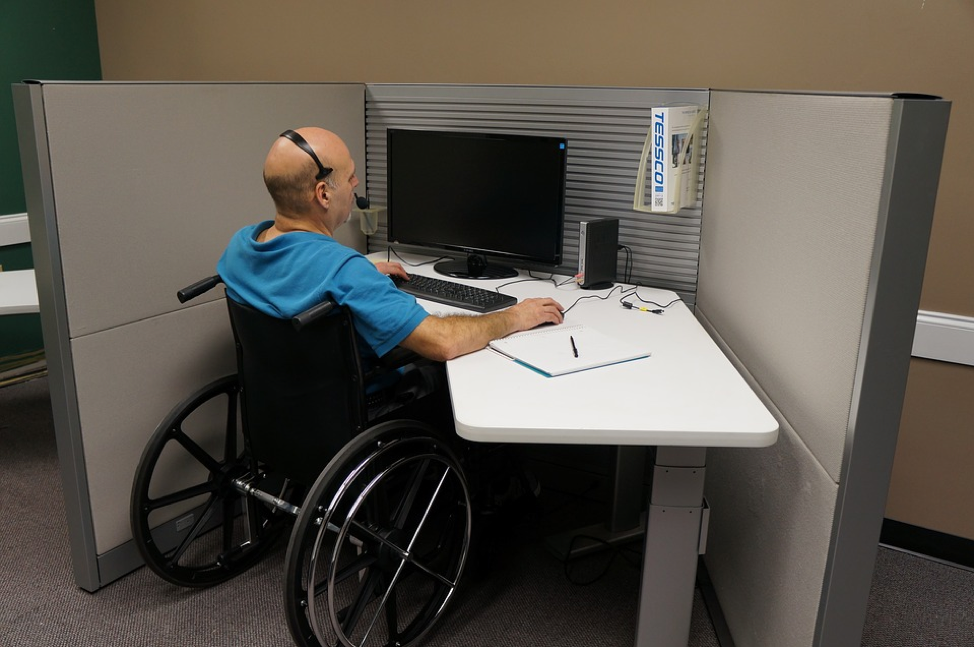
Getting and keeping a job you like is difficult for anyone, but it can be incredibly hard for someone with a disability. Having a sight, hearing or motor-function disability doesn’t make it impossible to get a good job, but it can be considerably harder. Fortunately, this age of technology has ushered in a wide variety of tools that can help professionals with disabilities.
One thing to keep in mind is that your phone can be instrumental in both using these technologies and in securing your career path. It’s your connection to everything important during your entire career, from job hunting to job advancement. Invest in an upgrade if you’re using an older model, and if you are tight on data, consider looking into pay as you go phone plans. It’s a great way to get exactly the data package you need for the time period you need it.
Smart Technologies That Help You Find Work
The process of applying for work is something most people take for granted, but it can be especially difficult if you have a disability.
Job tracker apps such as Huntr make it easy to keep track of all the jobs you’ve applied for in one place. No need to switch from site to site or keep every email. All the contacts and correspondence to any job you apply for is easily accessible and at your command.
Talking on the phone to schedule an interview can be a huge ordeal when you have certain disabilities. The RogerVoice app puts captions to voice calls so you don’t miss a word. Hearing-impaired people can make regular cell phone calls to anyone that understands sign language, and read their words with voice-recognition software.
People with motor-function disabilities use Dragon Naturally Speaking to help search the web for job opportunities, report research and anything else. It is voice-recognition software that employs voice commands for those who have trouble using the keyboard. Capterra explains this program is a leader in the industry and is favored by attorneys, physicians, and others in the professional sector.
Smart Technologies That Help You Advance in Your Career
Most workplaces are not entirely accessible to disabled people, making it harder to advance in our careers. The Americans with Disabilities Act made it illegal to discriminate against employees and job seekers with disabilities. This includes implementing structural and technological changes needed to employ them, and many of those options are low-cost. Don’t hesitate to ask for tech tools like these if you’re climbing higher in your current organization.
The HearYouNow iPhone app is useful for those with hearing disabilities who do not use a hearing aid. When used during a meeting, it takes out background and foreground noises to focus on the speech.
BeMyEyes is an app that helps visually challenged people navigate the world around them. Volunteers answer video calls from users who need help reading something, gauging distance, getting directions or anything else a seeing person can assist with. American Foundation for the Blind explains this is a powerful platform for users that’s well worth considering.
JAWS is a computer screen reader for the visually disabled. It reads what is on the screen and provides a Braille output system for many of the most widely used computer systems. Every action on the keyboard results in an audio confirmation making it simple for visually impaired workers to work on a computer.
America has made great strides in inclusion for the disabled workforce, but there is even more work to be done. Great things are on the horizon. New technologies are developed all the time that enable everyone to enter the workforce and share their talents with the world, so take advantage of these wonderful tools and further your career.
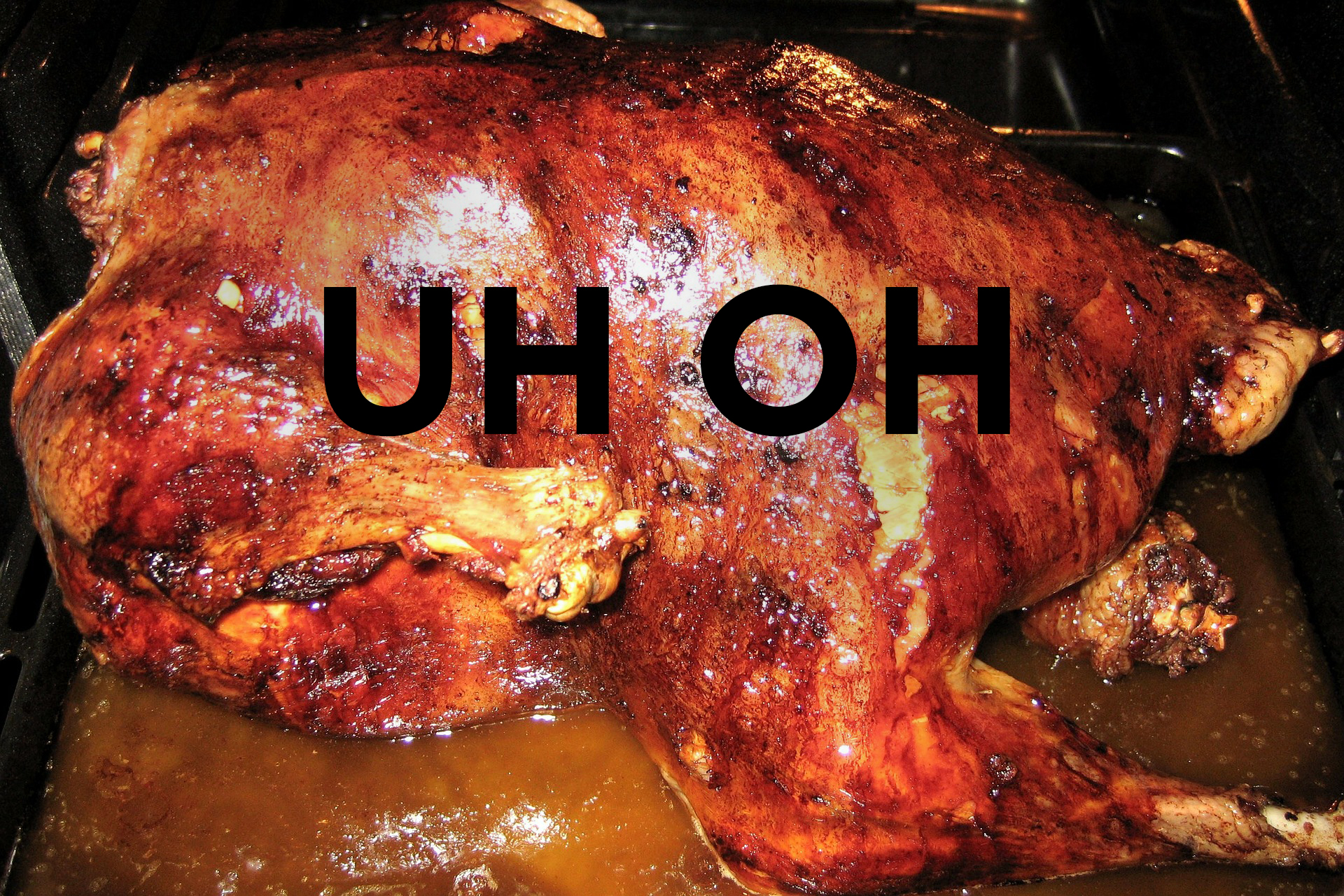
As our Happy Thanksgiving to you, we want to share some of our best Thanksgiving fails. So here’s to a little chuckle and some stress relief as we navigate our kitchens, families and friends.
The cat made me do it
I was multitasking in the kitchen as you often do during
holiday meal prep and was in the middle of making cinnamon rolls when the cat
started pestering for food. I set the container of frosting down and quickly
opened a can of cat food. After feeding the cat, I went back to making the
rolls and grabbed the lid to the frosting container for a moment of guilty
pleasure. Something tasted off as I ran my tongue across the lid… of the cat
food container. I never looked at cinnamon rolls the same. -Lisa P
Uninvited Guests
The year my grandma passed away, we happily agreed to carry
the prepared turkey to grandpa’s house and cook everything there. We fired up
the oven and got to cooking. After a bit we noticed a very strange and
unpleasant odor. After investigating we found that mice had made a nest in the
back of the oven. So that year we celebrated around a bucket of Kentucky Fried
Chicken with all the windows open. -Carrie G
Deep fried garage
My brother and dad decided one year to jump on the
deep-fried turkey bandwagon and fry one themselves—in the garage. After a few
adult beverages, turkey tending duty became less of a priority until mom came
into the house and said, “are you aware the garage is on fire?” -Darren
A little something extra…
I was making a turkey and forgot to pull out the bag of bag
of turkey parts that was in the butt of the turkey. So when we were cutting and
eating it, a white bag started showing….OOPS! We got a turkey butt surprise!
-Amanda
Dogs are quick
I was letting the cooked turkey rest on the counter and
turned around for only a second which proved to be my downfall. When I turned
back, I saw our dog Lola standing on her hind legs, going to town on the
turkey. We ate it anyway. -Anonymous
Turkey Pudding
My friend and I decided we would try our hand at making
gravy from the turkey drippings. She got the gravy started and when I checked
on it a bit later, I decided it was time to add the thickener. While I was
setting the table, I heard my friend say “what the ____” from the kitchen.
Apparently, we had both added cornstarch and voila! Turkey pudding was born.
Sigh. -Brett
In the bag
I never mess up anything…but… One year I had heard about cooking turkeys in a paper bag. So, I thought, “I need to try that”. I prepared the turkey like I usually do. and put it in the paper bag and popped it in the oven. After about an hour, I started to smell something burning! I opened the oven and the paper bag was starting to go up in flames. Apparently, I missed the part about spraying the inside of the bag with cooking oil. -Kathy