Disability Network Michigan’s Statement on Federal Funding Pause

Individuals with Disabilities Among Those Negatively Impacted

by Recent Pause on Federal Funding

Services for over 2 million Michigan residents with disabilities to

stop under funding freeze

LANSING—With the announcement of a pause in federal funding for grants, loans and other financial assistance programs, Michigan’s 15 Centers for Independent Living (CILs) are working diligently to assess how many services and resources will be immediately impacted for people with disabilities. Some services and resources will end as soon as February 1, 2025.

Michigan’s CILs provide services and resources for people of all ages and all disabilities. According to the Centers for Disease Control, about 14% of Michigan adults have one or more disabilities.

CILs are authorized under Title VII of the Federal Rehabilitation Act and are supported by funding from a variety of federal, state, and local sources. They provide an array of Independent Living services and supports tailored to the needs identified by the local disability community.

Michigan’s CILs work with individuals with disabilities in all 83 counties, including providing assistance to disabled veterans who face homelessness and providing temporary ramps for people to access their homes after an injury or surgery.

“Our Centers provide vital services and resources for people with disabilities,” said Alex Gossage, Chair of Disability Network/Michigan’s Board of Directors and Executive Director of Disability Network Washtenaw, Monroe, and Livingston. “A pause in federal funding means an immediate interruption of these services that many rely on to navigate the barriers that exist for people with disabilities.”

While each CIL designs their programs and resources based on local needs of the community, all CILs provide five core services: Advocacy, Information & Referral, School to Work Transition,

Peer Support, IL Skills Support, Transition to Community Based Living. These five core services empower people with disabilities to participate in their families, work, and communities.

“It is our hope that this pause in current federal funding contracts is lifted as soon as possible. This decision will have far-reaching consequences for some of our most vulnerable residents,” said Teri Langley, Executive Director of Disability Network/Michigan. “Michigan’s CILs have partnered for many years with the federal, state, and local governments in providing assistance to ensure people with disabilities are not forgotten. Continuing this partnership is critical.”

Disability Network/Michigan represents the collective voice of the state’s 15 Centers for Independent Living. DNM focuses on leadership development, relationship building, effective communication and mobilizing around issues that will have the greatest impact on delivering high-quality independent living services to people with disabilities.

The Lack of Politicians with Disabilities Is A Systemic Issue

Although recent disability population estimates by the Center for Disease Control and the US Census Bureau range from 13-25%; the true number remains widely unknown because of misinformation that creates disability mysticism. It’s a knowledge gap that manifests in people being unfamiliar with what is considered a disability and if they themselves have one. 

Despite the disability community being the largest minority group in the US, a 2.7-14.7 point disparity exists between the percentage of people living with a disability and the 10.3% of elected officials with a known disability. This elicits questions about why more politicians with disabilities are not elected into office- the answer has layers.

One reason is rooted in why it’s important to have disability representation in the first place. People from marginalized groups have a higher chance of bringing up issues that pertain to their respective group. Since not many people with disabilities run, issues relating to disabilities such as accessible health care and transportation, are frequently excluded from campaign talking points. As a consequence, people with disabilities may feel less empowered to partake in politics, including not voting or running for office, only perpetuating the cycle.

Political analyst Jennifer Wolak examines in her research entitled, “Feelings of Political Efficacy in the Fifty States,” the correlation between external and internal efficacies. Wolak differentiates external efficacy as the people’s perception level about if politicians care what they want while internal efficacy reflects how heard people think their opinions are in the political atmosphere.

Wolak explains that external efficacy is higher when the government produces policies indicative of constituents’ preferences, they’re more likely to construe they have a higher level of political influence, thus convincing them to participate more. As mentioned before, issues surrounding disabilities are either typically not enacted or even deliberated on any level of government.  

She also discovered internal efficacy rather is more responsive to the availability of voting opportunities like absentee ballots. These ballots in particular are important for people with disabilities because many encounter challenges when going to in-person voting stations. 

In fact, a Rutgers University study found that 18% of people with disabilities faced at least one challenge with in-person voting in 2020, double the rate of people without a disability. 74% of voters with disabilities instead opted for the absentee ballot method, which has retained its popularity specifically amongst this group. 

Despite this, since people with disabilities run into more voting troubles, they may feel less internal efficacy and therefore less initiative to run for office. Not to mention, Wolak discusses how many who lack internal efficacy tend to feel like they don’t have the resources to run, including social or political competence. For people with disabilities this perhaps stems from their societal isolation with about 40% of adults with disabilities in a 2021 University of Michigan report disclosing a sense of loneliness, likely due to stigmas against disabilities.

In a series of studies conducted by psychologist Kathleen R. Bogart, experiencing stigmas has been shown to be the greatest predictor of if someone identifies as having a disability as well. For centuries in US politics candidates were afraid to admit they have a disability, especially a cognitive one, exemplified by 1972 Vice Presidential candidate Thomas Eagleton. Eagleton withdrew after his depression hospitalizations were revealed to the public.

Incidents such as these can lead to internalization, where people begin to adopt these negative views of their own disabilities. It’s now been debunked though that mental illnesses affect intelligence levels with most being manageable with good treatment and medication.

To overcome these systemic barriers, Wolak concludes three ways the government can heighten efficacy in individuals include: diverse viewpoints in legal decisions, introduce legislation that citizens want and have institutions empower people to voice their opinions not limit them. 

Part of creating these structures would be the nullification of a current major legal obstruction for people with disabilities who run for office which is the “1999 Ticket to Work and Work Incentives Improvement Act.” An act that provides services like vocational rehabilitation and Social Security Disability Insurance to people with disabilities to help them return back to or enter the workforce. Yet, the Social Security Administration qualifies unpaid campaigning as work, meaning candidates with disabilities can have their benefits revoked. 

Many states have laws that require elected officials to be present for meetings and the price for interpreters on campaign trails and at the office is expensive in addition, but some legislators have introduced bills to waive in-person meeting requirements. As for the specific cases of addressing the Ticket to Work Act and lack of funding, there’s Pennsylvania Senator Bob Casey

His proposed “Removing Access Barriers to Running for Elected Office for People with Disabilities Act” would clarify that campaigning is not the same as obtaining an elected position. Meanwhile, the “Accessibility and Inclusion to Diversify Local Government Leadership Act” would allocate a portion of local government budgets to administer accommodations for officials with disabilities.

Acts like this are a part of a broader movement to help people with disabilities ensure they have the right to vote and the right to run for office. One major resource if you’re looking to support the cause is Disability Victory, an organization that trains on campaign strategies, acts as a network for politicians with disabilities and provides consultation for any of the mentioned.

How Michigan Law Empowers People with Disabilities to Vote

A key part of a democracy is holding elections that are open and accessible to everyone who is eligible to vote and are conducted fairly. Yet, people with disabilities have been shown to face more problems when voting. This number might go up because 14 states have put new voting restrictions in place for the 2024 presidential election. These include having shorter periods for absentee ballots, limiting who can aid a person in returns, earlier voter registration deadlines, and more. However, Michigan is 1 of 23 states that passed voting laws to make the process easier, which will apply to this election cycle. Learn how Michigan law empowers its residents to use their vote:

1. Absentee Ballots

These ballots may have been the most important method for raising the participation of voters, including those with disabilities. Michigan law has made this a choice since the 2020 pandemic-era election. A 2021 Rutgers University survey found that 74% of people with disabilities nationwide voted absentee or early in person. This way of voting helped lower the amount of reported difficulties by people with disabilities from 30% in 2012 to 18% in 2020.

  • Absentee ballots allow voters people with disabilities to avoid the chaos of crowded voting stations and allow an assistant to aid in their completion.
  • Voters with print disabilities may also apply for an electronic ballot with this link, which can be printed and returned to their local clerk’s office. When doing so, voters also have the choice to automatically be registered for electronic absentee ballots every election
  • There doesn’t have to be a reason to vote absentee, though, and any registered voter can opt for one in Michigan.
  • You can ask for one from the Department of State’s website with this link. You don’t have to finish it until 5 p.m. the Friday before election day, although it’s recommended to apply 2 weeks before to avoid delays with the mail. 

2. Early In-Person Voting

While voting on Election Day has become a more realistic choice for people with disabilities in Michigan, early in-person voting has become increasingly popular. As mentioned in the above portion, early in-person voting has greatly contributed to the decline in reported problems surrounding voting for people with disabilities. 

3. In Person Voting Accessibility

If someone with a disability chooses to vote in person on Election Day, polling stations must follow a couple of rules. First, the Americans with Disabilities Act (ADA) mandates revisions at public spaces to help people with disabilities partake in all parts of society, including voting.

  • This means that all polling places must admit service animals, and in Michigan, as of 2023, Public Act 75 of 2022 lets service animals in training to be admitted as well. 
  • Also, the ADA says that reasonable changes must be made to allow for equal participation. This can be done with temporary physical altercations to inaccessible buildings or by arranging wide pathways from check-in tables to voting stations. This includes offering the choice to send someone into the center and ask for curbside voting.
  • Once a person with a disability comes to the voting station, they may ask for help like language translation from a poll worker. Or they can bring anyone of their choice unless that person is their employer, an agent of their employer, or an officer of their union. 
  • A poll worker cannot force another person to accept their help.

4. Voter Assist Terminals

The Help America Vote Act of 2002 orders there to be at least one accessible voting system for people with disabilities at each polling place in federal elections. 

  • This typically manifests in the form of voting stations designed for people who are seated and voter assist terminals. They are touch screen machines that will mark a ballot with the voter’s choice and will be counted along with the other ballots. 
  • Michigan polling stations differ on which terminals they use based on the county, with either Hart Voting Systems, Dominion Voting Systems, or ES and S Voting System. Click on this link to discover how each system works. 
  • Genesee County uses the Hart Voting System.
  • All the voting terminals have a control panel of some kind and more than 1 screen so you can verify your choices.

Your Vote, Your Voice: Accessible Voting Event Champions Equal Access for Every Voter at Accessible Voting Information Session

The Disability Network (TDN) will host an Accessible Voting Information Session on Friday, September 13, from 2:30 to 5:30 at Gloria Coles Flint Public Library in recognition of Disability Voting Rights Week.  

With the presidential election only a few months away, it is more important than ever for Genesee County residents to be educated and empowered when it comes to voting. This is why TDN will be hosting an Accessible Voting Information Session.

A voter assist terminal is on showing a screen for a voter to make a choice.
Voter Assist Terminal
Photo credit Michigan Department of State

This informative and interactive event will empower and educate people on their rights and the accessible voting options available to them. Whether they’re a first-time voter or looking to learn more about voting accessibility, this event will provide valuable insights and hands-on tools for voting in upcoming elections.

A voter access terminal will be on-site for people to test and there will be remarks from Genesee County Clerk and Register of Deeds, Dominique Clemons, and Community Advocate and Trainer, Jessica Dixon, LCSW, about accessibility and voting for people with disabilities.

Additionally, the League of Women Voters Flint Area and the National Federation of the Blind Flint/Genesee Chapter will attend to support voters and celebrate accessible voting. An ASL interpreter will be present for this information session.

This will be one of many events TDN is hosting to bring education and empowerment to Genesee County voters.

[MEC id=”7166″]

“Back Into The Community” Harry Russell Regains Independence

Harry Russell has been working his entire adult life. Then at 60, he had a stroke.

Harry says, “My left hand went numb; I felt off.”

He’d been working as a cook at Jack’s Place in Flushing when the owner noticed Harry looked slightly different.

Harry says, “He said nothing is good about it; you need to go to the hospital.”

After an emergency stay at Hurley Medical Center, Harry was eventually released to a Montrose nursing care facility, Medi-lodge.

According to Harry, “It was scary facing a lot of strangers, but they cared for me and didn’t judge me. I just went through a catastrophe, and now I’m trying to piece everything together”.

After 15 months at Medi-Lodge, Harry wanted to move on with his life.

Harry says, “I want out; Medicaid would help if I’m out.”

His social worker contacted Caley Iverson at the Disability Network to help.

He was also assisted by Sarah Cheek, NFT Lead, from TDN.

Caley says,” Our NFT department is a Medicaid-based program where people come from a nursing home or hospital; we get them housing and ramps.”

Harry needed just about everything.

Caley said,” He needed accessible housing, a ramp, household items, groceries, furniture, pretty much everything. He was starting over”.

Harry is settled into a Flint apartment and now faces a lot of physical therapy. He hopes to walk again soon and get his old job back at Jack’s Place.

Caley adds, “He’s so excited to return to the community.”

Harry says, “If it wasn’t for the Disability Network, I don’t know where I’d be.” 

If you know someone in a nursing care facility who wants to move on to a more independent life, please get in touch with The Disability Network at 810-742-1800.

iKayak Returns This Summer to Genesee County

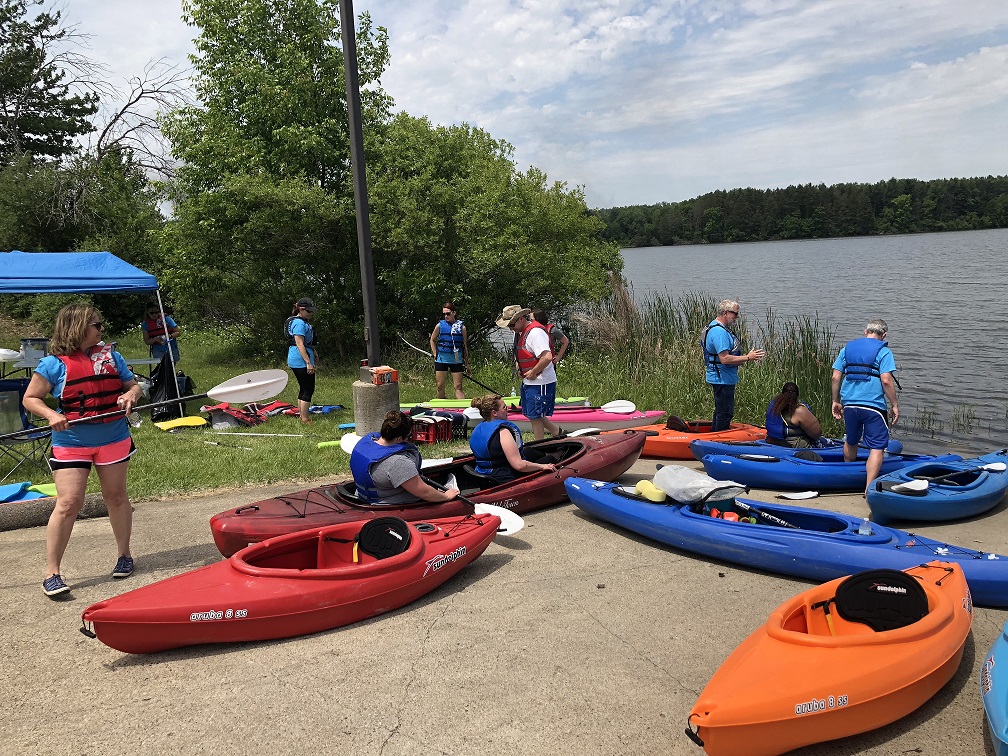
Developed to provide inclusive and accessible outdoor experiences, iKayak offers individuals with disabilities the opportunity to explore the Flint River’s waterways through adaptive kayaking. The program is back for 2023, promising memorable experiences and empowering individuals to connect with nature.

What started as a collaboration between The Disability Network and Kayak Flint, iKayak is a perfect example of the Flint River Watershed Coalition, Genesee County Parks, and KayakFlint’s commitment to inclusivity and ensuring that outdoor recreation is accessible to all. The program offers kayaking and equipment that adapts to various disabilities, including mobility and sensory experiences. These adaptive kayaks, equipped with stability features, comfortable seating, and assistive devices, provide individuals the freedom to navigate the waterways with ease and confidence.

iKayak Guides and Volunteers

What sets iKayak apart is its dedicated, passionate team of trained guides and instructors. These professionals have undergone specialized training to provide personalized support and assistance, ensuring a safe and enjoyable experience for every participant. Jaime Welch heads up iKayak and leads excursions. Tarah Holliman, recreation therapist at TDN, has worked with Jamie for the last two years and shares that “Jaime Welch is passionate about kayaking; she is passionate about people. She wants people to have the opportunity (to kayak) from all backgrounds.” Whether assisting with transfers or ensuring the proper fitting of adaptive equipment to offering paddling techniques and nature interpretation, the iKayak team goes above and beyond to make each outing memorable.

Those interested in volunteering are encouraged to sign up for an upcoming training session by KayakFlint.

A group of kayak volunteers are preparing to go out on the lake.

Independence and Exploration

For many, iKayak is a chance to reconnect with nature, experience the thrill of kayaking, and explore the beauty of some of Genesee County’s waterways. The program offers a variety of trips tailored to different skill levels and interests. From tranquil paddles to scenic explorations, iKayak carefully plans each trip for participants’ enjoyment.

Beyond the physical benefits of kayaking, iKayak fosters a sense of empowerment, independence, and social connection among its participants. Engaging in outdoor activities promotes physical well-being, boosts confidence, and nurtures an appreciation for nature. “iKayak is meant to show you that you can. You can do this for your whole life, not just the kayak sessions,” Tarah explained. “iKayak is a starting point for developing the skills, to teach safety, what to do on the water, so you know that you can do it safely and independently.”

Upcoming iKayak Events

Families, individuals, and groups are invited to join this inclusive and accessible outdoor recreation activity. Whether it’s your first time on the water or an annual tradition, iKayak promises an unforgettable experience that empowers, inspires, and connects participants with the Flint River. So, grab your paddle, embrace the adventure, and let iKayak take you on an extraordinary journey of discovery!

If you are interested in becoming a volunteer for the iKayak program, please reach out to Jamie Welch at 810-767-7140 or jwelch@flintriver.org.

[MEC id=”6537″]

Portraits of Persons with Disabilities photojournalist coming to TDN in May

The Disability Network will host Detroit-based photojournalist Laura Suprenant for her current series, Portraits of Persons with Disabilities. Laura shares on her website, “The Portraits of Persons with Disabilities Project aims to change the perception of PWD, starting with the people themselves. Through photography, we create a respectful portrait of each person’s unique form.” Learn more about this project on the Portraits of Persons with Disabilities Project Website.

Laura is looking for volunteers to be interviewed and have their portraits taken on May 25th at TDN’s office. If you are interested or know someone who would be, please email Laura at Laura.C.Suprenant@gmail.com. All scheduling will be done through Laura directly.

A women smiling while seated person and text that says 'Portraits of Persons with Disabilities Call for Volunteers! We are looking for volunteers with disabilities to be interviewed and have their portrait taken for series highlighting disability visibility. Portraits will be taken May 25, 2023 at the Disability Network in Flint. Email us today to reserve your spot! To sign up email: Laura.C.Suprenant@gmail.com

May Activities for TDN Connect

Join TDN Connect for this month’s recreation and health programs held at The Disability Network and around the community.

TDN Connect is a multi-faceted program series designed to help you learn new independent living skills by inviting you to participate in recreation and leisure programs.

Our series includes adaptive cooking, exercise, crafting, and mental health check-ins with tips and techniques. We are creating spaces for you to thrive and enjoy the social, physical, mental, emotional, and spiritual benefits of recreational programming.

In-person events are held at The Disability Network unless otherwise stated.

RSVP/registration is required for all classes. Please call or text Tarah at 810-730-0734 to save your spot in TDN Connect.

[MEC id=”6376″]

TDN Staff Share Tips For Inclusive and Accessible Recreation at State Conference

Two members of the TDN staff presented to Michigan’s parks and recreation professionals last month at the annual mParks conference in Lansing.

Jessica Dixon and Tarah Holliman shared the values of inclusion and accessibility in their respective presentations and provided resources and tips for participants.

“My presentation was about how to create inclusive programming in the parks,” Holliman shared. She provided easy ways that parks and recreation departments can get behind this work, for example, “going into the community and asking people what they need, what they want, and creating programming based on that.” She continued that it could include existing programs as well.

For organizations and programs interested in looking at making their current programming more accessible, Holliman shared examples to help, “For instance, at registration, you ask about their accommodations, what they need to do the program.” Additionally, organizers can “make it known that you have accommodations available like interpreters or something simple like providing seating with armrests and seat backs.”

The Disability Network organizes a number of recreational workshops, classes, and experiences for Genesee County residents. Its biggest outdoor activity is the iKayak program. Holliman says that the program works well, “because it’s three organizations coming together to provide an experience that persons with and without disabilities can enjoy independently throughout the county.” The Flint River Watershed and Genesee County Parks coordinate iKayak with activities planned throughout the summer.

TDN Connect, an independent living skills and recreational activities program led by Holliman, also fosters social interaction and independence in the community. “Current participants have shared with me that they participate [in TDN Connect] for the social aspect because they reported not having many friends,” Holliman shared.

With a goal to foster people with disabilities living and thriving independently in the community, TDN Connect “provides a space for people to authentically be themselves, learn and understand their own disabilities, and also gain skills to improve and maintain independence in their lives.”

The Bureau of Services for Blind Persons (BSBP) Hosts Open House at New Office

The Bureau of Services for Blind People (BSBP) welcomed visitors to its new location on March 23. Just down the road from its previous location, the new office is inside the Michigan Works building at 711 North Saginaw in downtown Flint.

BSBP employees from across the state gathered to explain their services. They help with job training along with independent living skills.

On Michigan’s Labor and Economic Opportunity Department website, BSBP is described as providing “training and services that empower people to achieve their individual goals. If you live in Michigan and you’re blind or visually impaired, the Bureau of Services for Blind Persons will work with you to define your goals and identify appropriate training and services.”

The BSBP also operates the state’s Bureau of Services for Blind Persons Training Center (BSBPTC), “a comprehensive rehabilitative center specializing in assisting youth and adults who are blind and have low vision. “

As a center of independent living, the Disability Network shares common goals with the group in providing services to support individuals’ goals for independent living and thriving in the community.

Learn more about BSBP at their website.

April Activities for TDN Connect

Join TDN Connect for this month’s recreation and health programs held at The Disability Network and around the community.

TDN Connect is a multi-faceted program series designed to help you learn new independent living skills by inviting you to participate in recreation and leisure programs.

Our series includes adaptive cooking, exercise, crafting, and mental health check-ins with tips and techniques. We are creating spaces for you to thrive and enjoy the social, physical, mental, emotional, and spiritual benefits of recreational programming.

In-person events are held at The Disability Network unless otherwise stated.

RSVP/registration is required for all classes. Please call or text Tarah at 810-730-0734 to save your spot in TDN Connect.

[MEC id=”6313″]

Sloan Longway Sensory-Friendly Planetarium Shows

Inside Flint’s Longway Planetarium.

It’s thrilling, it’s dramatic…

   But it might be too loud or hard to watch for some groups of people. So the good people of Longway have special events every month that are “sensory friendly”.

  Longway Planetarium’s Market Manager Anne Mancour says  “We turn the lights up a little bit and the sound down a little bit. Guests who aren’t used to sitting down for 45 minutes are able to get up and walk around”.

      The shows are for anyone who wants a more “chill” planetarium experience. It’s also designed for specific groups.

   According to Mancour,  “It’s typically for someone with sensory issues like a child with autism or someone on the autistic spectrum or have sensitivity to loud noises or flashing lights”.

     Why does Longway do this?

     “Our mission is to be accessible and inclusive to the community, so we want to make it something everybody can do” says Mancour.

     The next Sensory show is on Saturday, March 11, from 11 – 11:45am.

It’s called Secrets of the Universe. 

      With Genesee County residents getting 50% off, and military and teachers getting in free, it may be one of the best bargains in town.

       In Secrets of the Universe, show-goers are taken back to within a millionth of a second after the Big Bang. Award-winning IMAX documentary filmmaker Stephen Low takes audiences on an exciting science journey to Geneva, Switzerland, home to the massive Large Hadron Collider (LHC), the largest and most complex scientific instrument humans have ever built at nearly 17 miles around and buried 500 feet underground.

   All Longway Planetarium shows are 50% off for Genesee County residents: $4 adults, $3 seniors 60+, and $3 youth ages 2-11.
      
Sensory-Friendly Planetarium Shows at Longway Planetarium are funded in part by the Genesee County Arts Education and Cultural Enrichment Millage.