STUDENTS AT MSD GET HELP FROM THE DISABILITY NETWORK

By Joel Feick

Inside the modern Media Center at the Michigan School for the Deaf, students are learning about “hard skills and soft skills”.      

Two people standing at the front of a classroom, one is signing the other is speaking

TDN’s Youth Ambassador Amanda Banks is helping 5 students with hard skills like college and soft skills like time management.  The class is lead by Teresa Miracle, the Communications Director for the Communications Access Center, which is in a building nearby.   She brought a Level One interpreter, Kara Dougherty who verbalized the sign language.  

Woman signing in front of a whiteboard

One student had problem with alarm clocks for people who are deaf.  Banks used it as example of something the students can learn from. Amanda told the students, “if you don’t have something you need, advocate for yourself, ask.”   

4 people speaking with each other at the front of a classroom

After class Miracle and Dougherty agreed, interpreters are in high demand. It can be a noble and lucrative job, they said.

Home for the holidays

By Joel Feick


Photos of Mike and Kathy at the nursing facility and Mike sitting in his recliner in his new apartment

For the past 3 months, 50 year old Mike has called Fenton Health Care his home.

When he developed cellulitis in his leg, he went from a hospital to a rehab facility to nursing care.

But he really couldn’t wait to get out.

The Flint native says a 2005 spinal tap left him in constant pain. As a result, he’s developed 4 different types of arthritis.

He’s been unable to work, but receives social security-disability.

TDN’s Nursing Facility Transitions Team Leader, Kathy McGeathy, helped Mike with his transition into an apartment in Montrose, so he can live independently.

McGeathy is the Nursing Facility Transitions Team Leader at TDN.

She moved some of his clothes and arranged for the movers to bring his bed and other belongings.

Kathy even helped build him a seat for use in the shower.

Mike says he’s happy to be living independently again and is thankful for all the help from Kathy and the team at TDN.

If you’d like to support TDN’s work, click the donate button below!

Donate Button

To learn more about The Disability Network, visit www.disnetwork.org

The Best Tech Tools For Professionals with Disabilities

By Patrick Young, ableusa.info

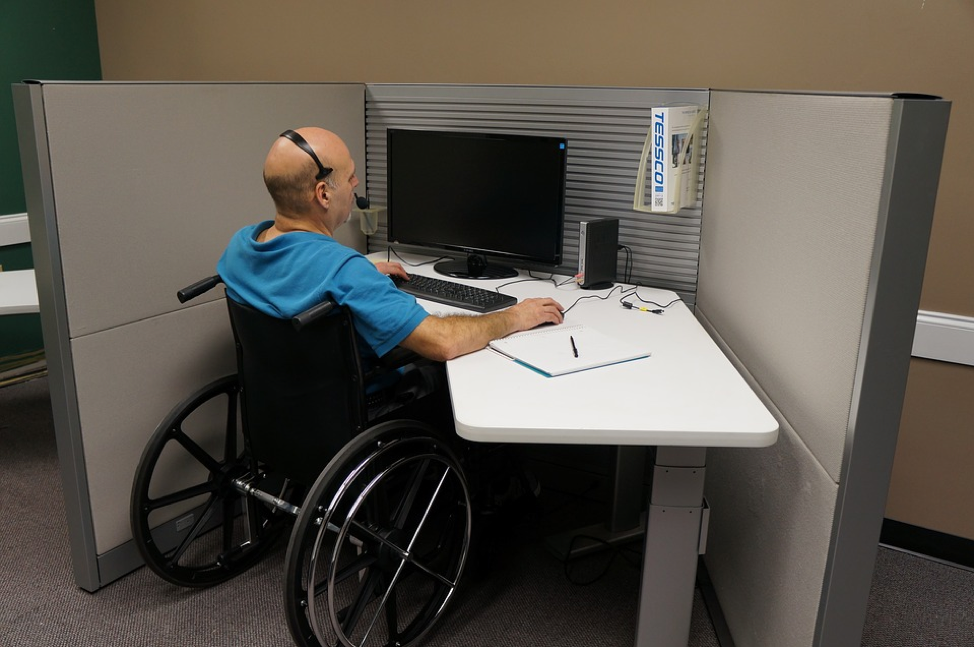
Man in wheelchair working at a computer workstation

Getting and keeping a job you like is difficult for anyone, but it can be incredibly hard for someone with a disability. Having a sight, hearing or motor-function disability doesn’t make it impossible to get a good job, but it can be considerably harder. Fortunately, this age of technology has ushered in a wide variety of tools that can help professionals with disabilities.

One thing to keep in mind is that your phone can be instrumental in both using these technologies and in securing your career path. It’s your connection to everything important during your entire career, from job hunting to job advancement. Invest in an upgrade if you’re using an older model, and if you are tight on data, consider looking into pay as you go phone plans. It’s a great way to get exactly the data package you need for the time period you need it.

Smart Technologies That Help You Find Work

The process of applying for work is something most people take for granted, but it can be especially difficult if you have a disability.

Job tracker apps such as Huntr make it easy to keep track of all the jobs you’ve applied for in one place. No need to switch from site to site or keep every email. All the contacts and correspondence to any job you apply for is easily accessible and at your command.

Talking on the phone to schedule an interview can be a huge ordeal when you have certain disabilities. The RogerVoice app puts captions to voice calls so you don’t miss a word. Hearing-impaired people can make regular cell phone calls to anyone that understands sign language, and read their words with voice-recognition software.

People with motor-function disabilities use Dragon Naturally Speaking to help search the web for job opportunities, report research and anything else. It is voice-recognition software that employs voice commands for those who have trouble using the keyboard. Capterra explains this program is a leader in the industry and is favored by attorneys, physicians, and others in the professional sector.

Smart Technologies That Help You Advance in Your Career

Most workplaces are not entirely accessible to disabled people, making it harder to advance in our careers. The Americans with Disabilities Act made it illegal to discriminate against employees and job seekers with disabilities. This includes implementing structural and technological changes needed to employ them, and many of those options are low-cost. Don’t hesitate to ask for tech tools like these if you’re climbing higher in your current organization.

The HearYouNow iPhone app is useful for those with hearing disabilities who do not use a hearing aid. When used during a meeting, it takes out background and foreground noises to focus on the speech.

BeMyEyes is an app that helps visually challenged people navigate the world around them. Volunteers answer video calls from users who need help reading something, gauging distance, getting directions or anything else a seeing person can assist with. American Foundation for the Blind explains this is a powerful platform for users that’s well worth considering.

JAWS is a computer screen reader for the visually disabled. It reads what is on the screen and provides a Braille output system for many of the most widely used computer systems. Every action on the keyboard results in an audio confirmation making it simple for visually impaired workers to work on a computer.

America has made great strides in inclusion for the disabled workforce, but there is even more work to be done. Great things are on the horizon. New technologies are developed all the time that enable everyone to enter the workforce and share their talents with the world, so take advantage of these wonderful tools and further your career.

Thanksgiving fails

As our Happy Thanksgiving to you, we want to share some of our best Thanksgiving fails. So here’s to a little chuckle and some stress relief as we navigate our kitchens, families and friends.

The cat made me do it

gray striped cat eating from dish

I was multitasking in the kitchen as you often do during holiday meal prep and was in the middle of making cinnamon rolls when the cat started pestering for food. I set the container of frosting down and quickly opened a can of cat food. After feeding the cat, I went back to making the rolls and grabbed the lid to the frosting container for a moment of guilty pleasure. Something tasted off as I ran my tongue across the lid… of the cat food container. I never looked at cinnamon rolls the same. -Lisa P

Uninvited Guests

The year my grandma passed away, we happily agreed to carry the prepared turkey to grandpa’s house and cook everything there. We fired up the oven and got to cooking. After a bit we noticed a very strange and unpleasant odor. After investigating we found that mice had made a nest in the back of the oven. So that year we celebrated around a bucket of Kentucky Fried Chicken with all the windows open. -Carrie G

Deep fried garage

Cartoon character waving arms and yelling

My brother and dad decided one year to jump on the deep-fried turkey bandwagon and fry one themselves—in the garage. After a few adult beverages, turkey tending duty became less of a priority until mom came into the house and said, “are you aware the garage is on fire?” -Darren

A little something extra…

I was making a turkey and forgot to pull out the bag of bag of turkey parts that was in the butt of the turkey. So when we were cutting and eating it, a white bag started showing….OOPS! We got a turkey butt surprise! -Amanda

Dogs are quick

Brown dog peeking over a counter

I was letting the cooked turkey rest on the counter and turned around for only a second which proved to be my downfall. When I turned back, I saw our dog Lola standing on her hind legs, going to town on the turkey. We ate it anyway. -Anonymous

Turkey Pudding

My friend and I decided we would try our hand at making gravy from the turkey drippings. She got the gravy started and when I checked on it a bit later, I decided it was time to add the thickener. While I was setting the table, I heard my friend say “what the ____” from the kitchen. Apparently, we had both added cornstarch and voila! Turkey pudding was born. Sigh. -Brett

In the bag

Hand jutting out of paper bag clutching fresh herbs

I never mess up anything…but… One year I had heard about cooking turkeys in a paper bag. So, I thought, “I need to try that”. I prepared the turkey like I usually do. and put it in the paper bag and popped it in the oven. After about an hour, I started to smell something burning! I opened the oven and the paper bag was starting to go up in flames. Apparently, I missed the part about spraying the inside of the bag with cooking oil. -Kathy

Photo collage of people engaged in TDN activities with the giving tuesday logo and December 3, 2019

A taste of independence

By Joel Feick

Inclusive kitchen classes from The Disability Network are timely ahead of biggest kitchen week of the year

Inside the Flint Farmers Market, 2 great-grandmothers sat side by side in wheelchairs listening. And occasionally eating.

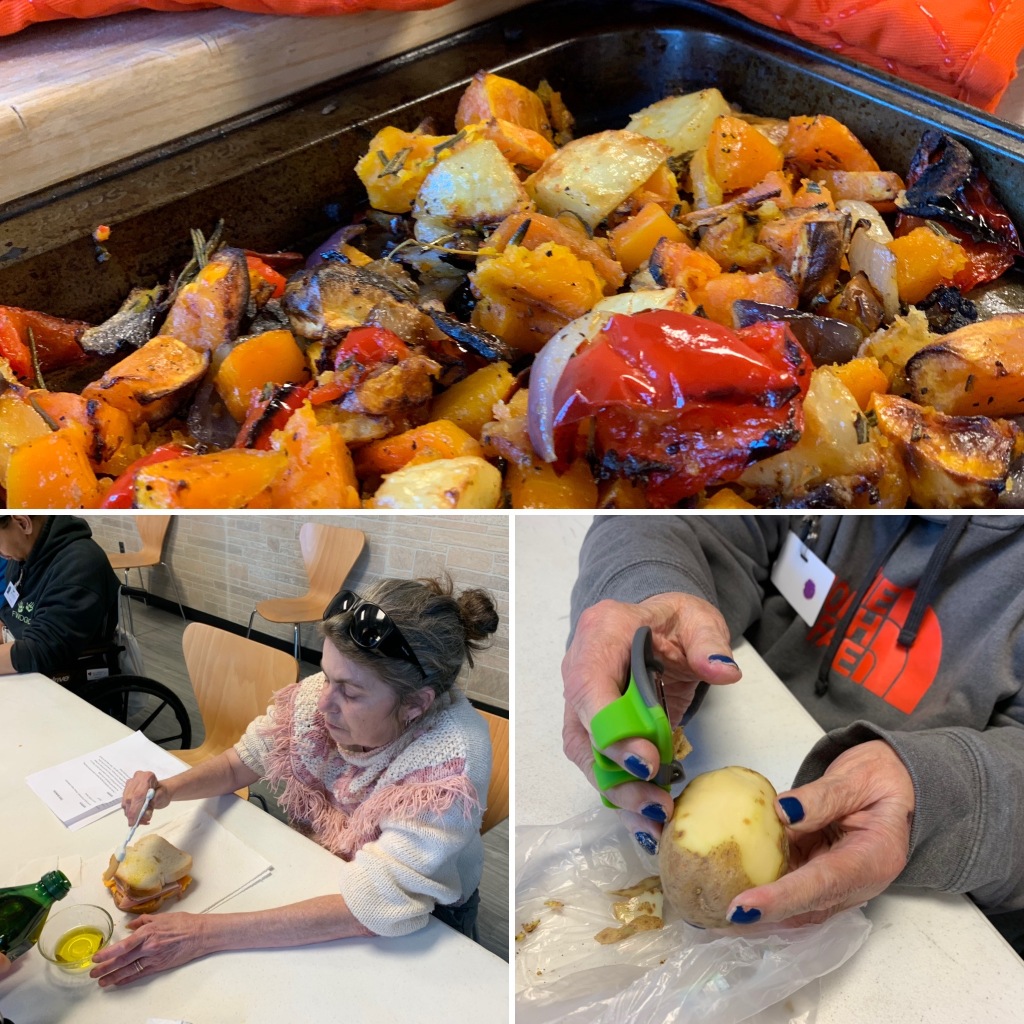
Photo collage of roasted vegetables and two people preparing food.

They are part of an Adaptive Kitchen class, taught by TDN’s Carrie Gerdeman.

This is a 4-week class with senior citizens with disabilities.     

The women, 80 year old Peggy Sexton and 82 year old Dalia Albiar, are among a group participating in the class. Although Albair is best known for her tamales, she says she enjoyed the class and learned a few things from Carrie. 

It Included the use of an adaptive potato-peeler. Each participated in making their own food creation. On this day it was panini sandwiches and grilled vegetables.

Gerdeman says “we will be using remainder of grant funds from the Community Foundation to create our adaptive kitchen and cooking program in the new building.  We will be using any donated funds for purchase of food and staff for expansion of the adaptive cooking program”. 

Participant using an adaptive cutting board to slice an onion
Woman placing a sandwich onto a panini press

Social Ties and Wellness Project

Two women seated across from each other at a table having a conversation

Participants are needed for a survey conducted by the Department of Public Health, University of Michigan-Flint!

Are you:

  • Between the age 20-64 years
  • Having difficulty with ambulation, self-care or independent living
  • Able to follow verbal directions inEnglish
  • Able to meet in person at The DisabilityNetwork

The Disability Network | 3600 S Dort Highway Suite 54 | Flint, MI 48507


For questions or additional information, please contact:

Sabah Ganai, GraduateStudentCo- Investigator

Phone: 810-762-3462 Email: sganai@umich.edu

Heather Mitchell: a writer’s journey

How many authors do you know who began their career writing love letters for people? Well, that’s exactly how poet and novelist Heather Mitchell broke into the business. Heather’s inspiration for writing comes when “the zone” finds her and it first started finding her in middle school. 

“Poetry has always come natural,” Heather explains, “it’s a way of expressing my deepest emotions.” And, as it turned out, she helped others express their emotions as well when she began writing love letters as a pre-teen for classmates to give to their crushes—for a small author’s fee. “[I] made pretty good cheddar for a while,” Heather said of her young entrepreneurial self, “until a teacher caught me.” While her teacher reprimanded her, it may not be for the reason you think. She told Heather that she was a good writer and to be sure not to sell herself short.

Heather graduated valedictorian of her high school class, then went on to earn a degree in child development with highest honors. She currently works in the preprimary education division of Davison Community Schools and has been with the division for over 17 years. She has always loved kids and her favorite part of her work is watching them grow up, “it’s an amazing thing to watch.”

When it comes to the topic of her disability, Heather is very open about it. She is visually impaired and invites others to ask questions and have conversations. “People often ask if I would fix my eyesight and are surprised when I say ‘no.’ I was put here for a purpose and meant to be an advocate. I am proud of who I am.”

Her determination shows through her journey to becoming a published author. Heather has been writing for over 30 years and it took her 15 years of that time to get her first book, an anthology of chronologically arranged autobiographical poems entitled Heart Mind and Soul, published. She followed that up with her novel, a modern romantic tragedy entitled Eastern Flame

When asked if she has any support to offer other people with disabilities navigating employment, she advises “be proud of who you are and make the best of it. Use your disability to educate others.”

You can find Heart, Mind and Soul here and updates on the rerelease of Eastern Flame can be found on here social media here.  As a special treat, Heather has given us permission to share a poem with our readers as a preview of what you can find in her book:

Writer’s Creed

I sit down to write, clearing each jumbled thought.

May my labors be fruitful instead of for naught.

The blank page before me is an open dance floor.

It beckons two willing artists, and not any more. 

This pen is my lover, as we sway growing near.

Its power to inspire I’ve come to revere.

My partner I hold tightly inside eager fingers,

With each line that appears, tingly excitement lingers.

Ink tracks on the page that we leave behind,

Are the creative musings of an unfettered mind.

A day without learning is one lost indeed.

I lay here before you my writer’s creed. 

National Disability Employment Awareness Month

By Cyndi Woods

October is National Disability Employment Awareness Month! NDEAM was put into effect by congress for the first week in October back in 1945. I personally am so very grateful that our congress has recognized disability employment as valuable enough to dedicate an entire month for raising awareness. October also happens to be my birthday month so it holds an extra special bit of excitement for me! 

The theme for the 2019 NDEAM is “The Right Talent, Right Now.” This theme is designed to point out the vital and essential role people with disabilities play in the work force. In a time of unprecedented unemployment rates, it is now more than ever that people with disabilities need to be seen for their contributions to the success of the work force.   

The disability community can offer talents to a business that cannot be found elsewhere. In a time of greater accessibility from a technical stand point, employing folks with disabilities is becoming easier for businesses. We also bring a level of empathy, compassion, and grace to a situation that may not otherwise be present. My dream would be to own a business of my own completely operated by individuals who have been turned down in the work force simply because of their disability. We as a society can not continue to exist if we keep closing the doors to people with disabilities. 

If you own a business, consider getting yourself a poster from The Department of Labor online to support disability awareness month. Maybe you are not a business owner but want to support this issue, go to the same site and download a copy or some of the other resources. 

Maybe part of your fight looks like creating a social media post to support this topic. Maybe it looks like writing an article to your local newspaper. Maybe it looks like a radio appearance… whatever you have access too, use it. 

If you have been turned down over and over for a job because of your disability, I plead with you not to give up trying! We can choose to be the ones who fight or the ones who sit on the sidelines while others fight. It’s much more rewarding to be a part of the group that fights. Be a Rocky Balboa… go the distance! Don’t give up! You could be part of the movement that changes history forever! Until next time, claim your courage, then claim your victory! 

Headshot of Cyndi Woods

Employment success

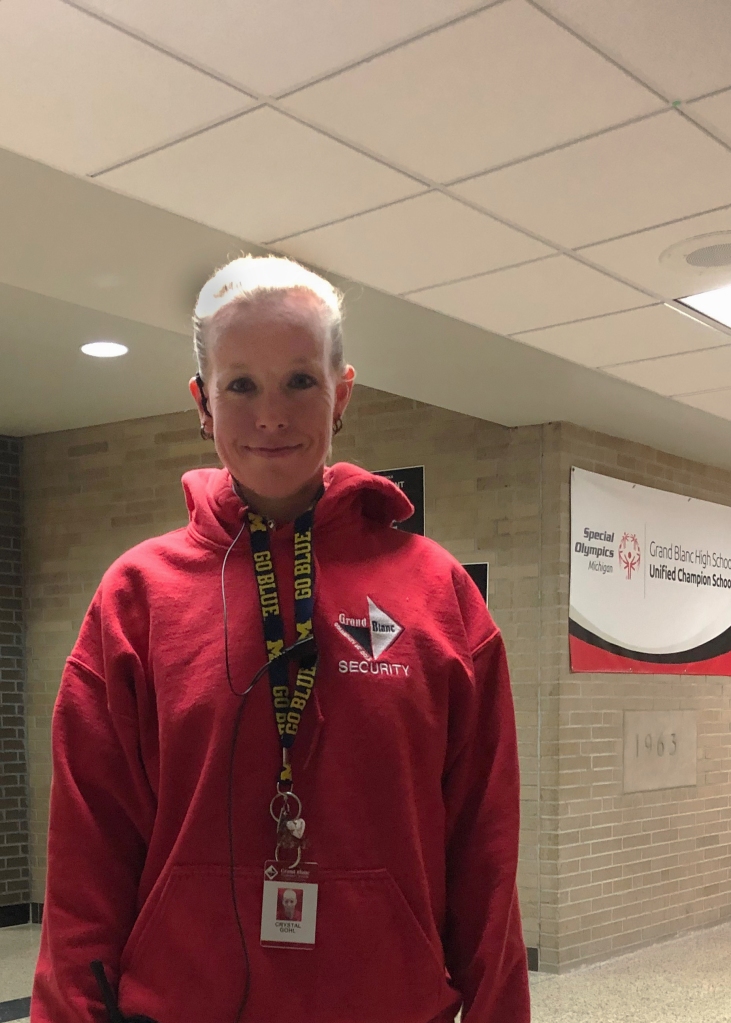
Crystal smiling and standing in the hallway of Grand Blanc High School. She is wearing a red hoodie and has a U of M lanyard around her neck.

Crystal came to The Disability Network (TDN) with a clear goal: to get a job. She immediately connected with TDN’s Job Club which provides wrap-around supports for customers who are actively applying for employment in their surrounding community. Customers receive one-on-one assistance in job searching, uploading documents, completing assessments, and documenting their activity in a journal. 

“When customers get their call for an interview, staff provides a mock interview with constructive feedback so the next call that the customer receives is, ‘you’re hired!’” said Kelly Milam, Employment Specialist at TDN. 

When Crystal joined Job Club, she made it clear that income wasn’t the only the only reason for seeking employment. “I wanted to get out [into the community] and meet new people,” and develop a bigger network. She worked to develop interview skills, résumés and cover letters and completed numerous job applications. She also worked on developing a support network.

One person, or “champion” as Crystal described, who she added to her professional network helped advocate with Crystal’s future supervisor during the hiring process. Crystal finally got called for an interview and was offered and accepted a security position at Grand Blanc High School. “Everything is going really good,” Crystal said of her job experience. “I really enjoy it.” 

When asked about the work culture, Crystal feels it’s very open and inclusive. “At the end of the day, my boss just wants someone who is trustworthy and dependable, which really has nothing to do with disability.” Disability isn’t seen as a weakness, just a part of who the person is.

“I greatly appreciate TDN and everyone who works there, especially Carrie D, Kelly and Gina.”

The leaves are a changin’, are you?

Closeup of a single red maple leaf upright in the grass

By Cyndi Woods

Oh how I love the Autumn season! The air gets crisper, fireplaces are glowing, candles are burning and the wonderful aromas of baked goods waft through the house. It’s just my favorite time of year.    

I only have ten percent vision but when I hold a bright red leaf up close, it appears to be on fire. The hues of orange, yellow, purple and red are my happy place. I know the scientific reason for these glorious colors have to do with chlorophyll breaking down and halting the nutritional process they are responsible for, but I have another way of looking at it.    

In late Fall, pretty much all the leaves have made their floating decent to the yards and fields spread out over the landscapes. Frustrated home-owners will yet again lace up boots and pull on work gloves to go retrieve the rake from the shed and repeat the task of raking, gathering, and bagging, hopefully for the last time this season. But this process of the trees shedding their leaves is also the process of letting go of the old and making room for the new.

We may be holding onto old hurts, past regrets or ancient unchangeable decisions, but if we don’t “shed our old leaves”, there will be no room for the new ones. Did you know that when snow piles up on leaves that have not been released from their branches they will eventually break the whole branch off the tree? Letting go of past things that will eventually break us allows for the new to make its entrance and begin offering the life-giving nutrients that we need.

What old leaves do you need to shed in order to make room for new life-giving leaves? Don’t let old leaves break you. Let them fall away and create space for rich nutritious leaves that will feed you. Enjoy the beautiful colors those old leaves have created in your life— they served a purpose. But look forward to the buds of new growth on the horizon. Happy Fall Y’all! Until next time, claim your courage, then claim your victory!    

Headshot of Cyndi Woods

Cyndi woods is TDN’s writer in residence. You can find out more about her at www.cyndiwoods.com

Be prepared for disasters

Firefighter pointing while standing in front of a collapsed structure

September is National Preparedness Month which promotes family and community disaster and emergency planning now and throughout the year. People with disabilities are significantly more impacted by disasters and emergencies. Here are some tips to help you, your family and friends be more prepared in the event of a disaster.*

Get Informed

  • Know what disasters could affect your area, which could call for an evacuation and when to shelter in place.
  • Keep a NOAA Weather Radio tuned to your local emergency station and monitor TV, radio, and follow mobile alert and mobile warnings about severe weather in your area.
  • Download the FEMA app, receive weather alerts from the National Weather Service for up to five different locations anywhere in the United States.

Make a Plan

How might a disaster affect you? Could you make it on your own for at least three days? After a disaster, you may not have access to a medical facility or even a drugstore, so it’s crucial to plan for the resources you use regularly, and what you would do if those resources are limited or not available. Additional planning steps should include:

  • Create a support network. Keep a contact list in a watertight container in your emergency kit.
  • Be ready to explain to first responders that you need to evacuate and choose to go to a shelter with your family, service animal, caregiver, personal assistant, and your assistive technology devices and supplies.
  • Plan ahead for accessible transportation that you may need for evacuation or getting to a medical clinic. Work with local services, public transportation or paratransit to identify your local or private accessible transportation options.
  • Inform your support network where you keep your emergency supplies; you may want to consider giving one member a key to your house or apartment.
  • Contact your city or county government’s emergency management agency or office. Many local offices keep lists of people with disabilities so they can be helped quickly in a sudden emergency.
  • If you are dependent on dialysis or other life-sustaining treatment, know the location and availability of more than one facility.
  • If you use medical equipment in your home that requires electricity, talk to your doctor or health care provider about how you can prepare for its use during a power outage.
  • Wear medical alert tags or bracelets.
  • If you have a communication disability, make sure your emergency information notes the best way to communicate with you.
  • If you use an augmentative communications device or other assistive technologies, plan how you will evacuate with the devices or how you will replace equipment if lost or destroyed.  Keep model information and note where the equipment came from (Medicaid, Medicare, private insurance, etc.)
  • If you use assistive technology devices, such as white canes, CCTV, text-to-speech software, keep information about model numbers and where you purchased the equipment, etc.
  • Plan how you will communicate with others if your equipment is not working, including laminated cards with phrases, pictures or pictograms.
  • Keep Braille/text communication cards, if used, for 2-way communication.
  • Preparedness tips for diabetics.
  • The U.S. Department of Health and Human Services online tool helps people locate and access their electronic health records from a variety of sources.
  • Plan for children with disabilities and people, who may have difficulty in unfamiliar or chaotic environments.

Get your benefits electronically

A disaster can disrupt mail service for days or weeks. If you depend on Social Security or other regular benefits, switching to electronic payments is a simple, significant way to protect yourself financially before disaster strikes. It also eliminates the risk of stolen checks. The U.S. Department of the Treasury recommends two safer ways to get federal benefits:

  • Direct deposit to a checking or savings account. Federal benefit recipients can sign up by calling (800) 333-1795 or sign up online
  • The Direct Express® prepaid debit card is designed as a safe and easy alternative to paper checks. Call toll-free at (877) 212-9991 or sign up online

Build a Kit

In addition to having your basic survival supplies, an emergency kit should contain items to meet your individual needs in various emergencies. Consider the items you use on a daily basis and which ones you may need to add to your kit.

Tips for People who are deaf or hard of hearing:

  • A weather radio with text display and a flashing alert
  • Extra hearing-aid batteries
  • A TTY
  • Pen and paper in case you have to communicate with someone who does not know sign language

Tips for People who are blind or have low vision:

  • Mark emergency supplies with Braille labels or large print.  Keep a list of your emergency supplies, and where you bought it, on a portable flash drive, or make an audio file that is kept in a safe place where you can access it.
  • Keep a Braille, or Deaf-Blind communications device as part of your emergency supply kit.

Tips for People with Speech Disability:

  • If you use an augmentative communications device or other assistive technologies, plan how you will evacuate with the devices or how you will replace equipment if lost or destroyed.  Keep Model information, where the equipment came from (Medicaid, Medicare, private insurance, etc.)
  • Plan how you will communicate with others if your equipment is not working, including laminated cards with phrases and/or pictogram.

Tips for People with a mobility disability:

  • If you use a power wheelchair, if possible, have a lightweight manual chair available as a backup. Know the size and weight of your wheelchair in addition to whether or not it is collapsible, in case it has to be transported.
  • Show others how to operate your wheelchair. Know the size and weight of your wheelchair, in addition to whether or not it is collapsible, in case it has to be transported.
  • Purchase an extra battery for a power wheelchair or other battery-operated medical or assistive technology devices. If you are unable to purchase an extra battery, find out what agencies, organizations, or local charitable groups can help you with the purchase. Keep extra batteries on a trickle charger at all times.
  • Consider keeping a patch kit or can of sealant for flat tires and/or extra inner tube if wheelchair or scooter is not puncture proof.
  • Keep an extra mobility device such as a cane or walker, if you use one.
  • If you use a seat cushion to protect your skin or maintain your balance, and you must evacuate without your wheelchair, take your cushion with you.

Tips for individuals who may need behavioral support:

  • Plan for children with disabilities and people including individuals who may have post-traumatic stress syndrome (PTSD), who may have difficulty in unfamiliar or chaotic environments.
    • This may include handheld electronic devices loaded with movies and games (and spare chargers), sheets and twine or a small pop up tent to decrease visual stimulation in a busy room or to provide instant privacy, headphones to decrease auditory distractions, and comfort snacks and toys that meet needs for stimulation.

Additional Items:

  • At least a week-long supply of prescription medicines, along with a list of all medications, dosage, and any allergies
  • Extra eyeglasses and hearing-aid batteries
  • Extra wheelchair batteries (manual wheelchair if possible) and/or oxygen
  • A list of the style and serial number of medical devices. Include special instructions for operating your equipment if needed.
  • Copies of medical insurance and Medicare cards
  • Contact information for doctors, relatives or friends who should be notified if you are hurt.
  • Pet food, extra water, collar with ID tag, medical records and other supplies for your service animal
  • Handheld electronic devices loaded with movies and games (and spare chargers), headphones to decrease auditory distractions, and comfort snacks and toys that meet needs for stimulation.

*Courtesy of ready.gov

SPIL Writing Team – Consumer Representatives

Group of people working at a table
The Michigan Statewide Independent Living Council has a committee that writes the State Plan for Independent Living (SPIL). The SPIL establishes a blueprint for present and future independent living programs and services in Michigan. The SPIL Writing Team has representatives from the Michigan Statewide Independent Living Council and The Network of CILs and is seeking consumers to serve on the team.
The Consumer Representatives will offer feedback and information to the SPIL Writing Team on topics relevant to the SPIL and about statewide or community programs and services that impact the lives of individuals with disabilities. 
Please share this information with consumers: click here!