Request for COVID-19 Vaccine Review for People with Disabilities

On January 28, 2021, The Disability Network cosigned a letter to the state, along with the other centers for independent living across the state, to advocate for vaccine priorities. The entirety of the letter can be found below.


January 28, 2021

The Honorable Gretchen Whitmer Governor of Michigan
P.O. Box 30013
Lansing, MI 48909

Dear Governor Whitmer,

On behalf of the 1.9 million Michigan residents with disabilities, Disability Network of Michigan (DNM) is requesting a review of the current policies for the distribution of COVID-19 vaccines and the supports for this process that are being planned.

DNM asks of the Governor and MDHHS Director that:

  1. Prioritization of all people with disabilities age 16 to 64 is changed from Phase 1C to 1B.
  2. All materials involved in the vaccine registration process are accessible to those with disabilities.
  3. All vaccine distribution sites need to be fully accessible and accommodating to persons with disabilities.
  4. A prioritization schedule process is considered that does not require a person to prove their disability when they are already receiving services through a program where disability eligibility is already determined.
  5. All healthcare workers are encouraged to receive the vaccine to protect patients with disabilities as well as receive implicit bias training to ensure equal access to quality, in-person care.
  6. Funding for grassroots vaccine outreach and education.

Though DNM recognizes these concerns may have been previously considered, we believe it is imperative to re-assess these critical issues.

  1. DNM asks that prioritization of all people with disabilities age 16 to 64 be changed from Phase 1C to 1B, whether they live in congregate care settings or not. Based on current estimates, those in Phase 1C may not receive the vaccine until May 1 which exposes vulnerable people to further health issues and risk of death.  All individuals with disabilities should be considered a part of the high risk group and part of the Phase 1B due to their vulnerable conditions. Twelve states have already recognized this heightened risk of death and included people with high-risk medical conditions in Phase 1B. To delay this prioritization will put lives at risk.
  2. DNM would ask that the vaccine registration process be accessible to those with disabilities (including but not limited to learning and visual disabilities). We further ask MDHHS and local health departments to consider the barrier posed by computers being the dominant way to access vaccination registration and the unintentional effect and barrier this may have on vaccination delivery. It is critical to promote other options more widely and to provide alternatives. Without increased access, the critical issues we address below will become even more critical.
  3. Once people have been granted permission to the vaccine it is important to consider the accessibility of the sites where vaccines will be delivered. All vaccine distribution sites need to be fully accessible and accommodating within the Americans with Disabilities Act guidelines. Medical staff should be prepared to accommodate individuals who will be passengers in an accessible vehicle. In addition, home/mobile vaccination options must be developed as quickly as possible to avoid costly options such as ambucabs and ambulance rides to in order to receive the vaccine. CDC recommendations on vaccine distribution include suggestions for these scenarios and are available here: https://www.cdc.gov/vaccines/covid-19/implementation-strategies.html.
  4. People with disabilities who receive Long-Term Services and Supports (LTSS) through MI Choice Waiver Programs, the Home Help Services (HHS) program through MDHHS, the Program for All-Inclusive Care for the Elderly (PACE), and high school students or young adults age 16 and older who receive special education services, have already had their disability or underlying medical conditions determined to be served by these programs. We urge those who set the vaccine priority phases and the county-level health officials to use these already qualified statuses to determine eligibility in Phase 1B.  Persons with disabilities aged 16-64 should be able to request prioritization, through a current or previous medical provider. Persons without doctors or who are not signed up with the programs listed above should be allowed to confirm their disability status in another manner.  
  5. DNM further requests all healthcare workers be strongly encouraged to receive the vaccine to protect patients with disabilities as well as receive implicit bias training to ensure equal access to quality, in-person care. While Michigan has prioritized vaccine distribution to those who work in congregate living settings such as group homes and nursing homes, we must also focus on parents and guardians as well. These persons, while not employed outside the home as caregivers, are clearly as essential to our community’s well-being as those who are employed in these critical roles and represent the same risk of infecting those they care for.
  6. While DNM applauds the recent leadership by the state to engage the public through trusted community leader forums, DNM feels the effort must go further. Funding for grassroots vaccine outreach and education would allow our collective teams to fully engage in the process of promoting vaccination and helping more Michiganders obtain them.  DNM encompasses fifteen Centers for Independent Living (CILs) across the state, all uniquely situated to engage and build trust for segments of our population that may be hesitant to the vaccination.  CILs are community-based organizations, providing services to all disability types and all ages.  We are often the first stop for people with disabilities and their families.  Additionally, the majority of our collective staff are people with disabilities so local communities often view CILs as an approachable and dependable source of information.

We want to thank you for the consideration of these important issues and strongly encourage you to adopt them so that all Michiganders can be best served.

Respectfully Submitted,

Ann Arbor Center for Independent Living
Blue Water Center for Independent Living
Disability Advocates of Kent County
disABILITY Connections
Disability Network/Capital Area
Disability Network/Flint & Genesee
Disability Network/Lakeshore
Disability Network of Mid-Michigan
Disability Network/Northern Michigan
Disability Network/Oakland & Macomb
Disability Network Southwest Michigan
Disability Network Southwest Michigan/Berrien and Cass
Disability Network/Wayne County-Detroit
Disability Network West Michigan
Superior Alliance for Independent Living
Disability Network/Michigan

TDN 2020 Annual Report

Transitioning for Success

The past year presented several challenges for The Disability Network, our consumers, and our partners. COVID-19 created a unique set of obstacles, and social justice issues across the country raised ever-present concerns for a strong community continually striving for equity.

Despite the barriers caused by COVID, TDN adapted services and approaches to ensure consumers could receive our five core services. Traditionally, these services were offered face-to-face. Rather than shutting down departments or reducing services, TDN transitioned to alternative formats with consumers. We were able to stay connected with consumers, partners, and each other with some new technologies and perseverance.

TDN committed itself to engage in immediate and intentional action to ensure we are meeting the promise of our mission and holding up a core belief: “Nothing about us without us,” by addressing representation on our leadership team and our board.

We have prepared an accessible PDF for our annual report. If you would like to access the report in another format, please send a note to tdn@disnetwork.org.

What’s your story?

The Disability Network will be launching a campaign this year featuring our very own community. We are seeking individuals and families throughout Genesee County who are interested in sharing their stories and are comfortable being in front of a camera. The campaign will feature local residents with disabilities sharing their own stories with pride and in their own words. Disabilities are more than we think.

Our community is diverse and comprised of visible and invisible disabilities. Let’s tell people who we are. ❤️

Please fill out the form (external link opens in a new tab) and someone will follow up with you soon. If you have any issues completing the form below, you may send an email to tdn@disnetwork.org with your name and contact information. You can also call or text 810-444-7459.

For questions about The Disability Network or this campaign, send an email to tdn@disnetwork.org.

Service and Learning Opportunities for MLK Day 2021

Though events and service work may be different this year, there are still many ways to honor Dr. Martin Luther King Jr. on Monday, January 18th. There are ways to engage and give back virtually or in-person safely by wearing a mask and keeping a distance of at least six feet from others. Learn more about what’s going on in the community and commit to an act of service or learning this MLK Day.

Events

Learn more about events and learning opportunities across the county here.

  • John Lewis Good Trouble | Jan 21 at 5 PM EST – Jan 24 at 12 AM EST Learn more about and register for John Lewis Good Trouble(External link opens in a new tab)
  • Good Trouble Panel Discussion | Saturday, January 23 at 2 PM EST
    Learn more about and register for Good Trouble Panel Discussion (External link opens in a new tab)

Service

Commit to your community through volunteer work. The following events and services help connect volunteers to local organizations looking for helpers.

  • United Way’s Genesee Serves
    Learn more about Genesee Serves – (External link opens in a new tab)

You can also reach out to organizations and groups you feel passionate about to see what they need and how you can support them through time, talents, or treasures.

Is there a community event or service opportunity missing? Send a note to tdn@disnetwork.org so we can add it!

These are a few of our favorite things

We asked The Disability Network staff to name a few of their favorite things (and people) here at TDN. We will be sharing these stories and photos all way into 2021. From kayaking to sandwiches, to partners and magic, there are a lot of favorites at TDN — these are just a few!

If you have a favorite TDN thing, please share on social media using this hashtag #TDNFavorite. You can also send an email to tdn@disnetwork.org to share your favorite thing!

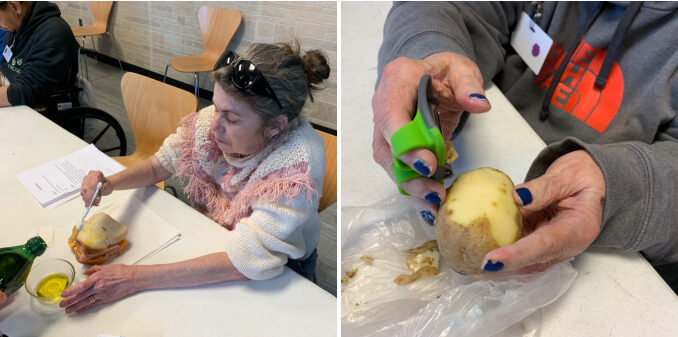
Cooking and Connection with TDN

Local residents can now learn recipes from the safety of their homes and connect with others while social distancing. The Disability Network will be offering adaptive cooking classes online starting in December. Classes can be accessed by computer, tablet, or phone.

Led by The Disability Network’s newest team member, Amario Rice, these classes will introduce adaptive cooking tools and techniques that can help home chefs of all expertise in the kitchen.

Ingredient lists will be provided leading up to class sessions so participants can get them before classes begin.

This program is supported in part by the Community Foundation of Greater Flint. The grant allowed The Disability Network to acquire technology for a limited number of participants.

However, there are many more people in our community who could use a tablet, internet access to join this class, and many other virtual classes that will be offered in 2021.

Donations made to our recreational programming will help us pay for tablets, internet access, mobile plans, and materials for local seniors and individuals with disabilities living independently in the community.

With your support, TDN can acquire materials needed to keep people connected to our programs and to each other. Donations can be made using Paypal.

New Ramp Program Starting at The Disability Network

The Disability Network is launching a new temporary ramp program in response to COVID-19 funded by the Community Foundation of Greater Flint. These ramps will help people transition out of the hospital and back to their homes quickly. Ramps are often considered unfunded medical equipment, forcing people to figure out how to get themselves or family members home when mobility has changed significantly.

“Flint Hospitals are at 97% capacity.  We need to reach people in hospitals right now during this third surge who need and want to get out immediately and would benefit from a temp ramp while they rehab.

In speaking with a local hospital about the ramps, [COVID patients] need them to get out of the hospitals now to clear space for the next patient.  A lot of the recovered COVID patients are too weak to get upstairs which prevents them from being discharged.  They will only need a ramp temporarily.”

Luke Zelley, CEO The Disability Network

Support Our Ramp Program

Other community ramp programs have waiting lists and take up to three months to build ADA and code-compliant ramps. Individuals need these quick temporary ramps to get them home to recover. Some require a temporary ramp while waiting for permanent solutions to avoid being sent to nursing facilities while they rehabilitate.

“A temporary ramp can provide quick access for people who face challenges getting in their front door. It’s especially helpful for people coming home from a hospital with additional medical issues. It’s one less thing to worry about. Funding these ramps can mean people get back into their homes in time for the holidays. You can be a part of their homecoming.”

Joel Feick, Director of Resource Development at The disability Network

This program is offered in part through the support of the Community Foundation of Greater Flint. Please consider a donation to our temporary ramp program to help us deliver more ramps to people in the community. The funds you give go directly to the cost of purchasing and installing these temporary ramps.

To donate to our ramp program, please click the button below. You will select Ramp Program from the drop-down on Paypal’s website. Link opens in a new window.

To learn more or make a donation to our temporary ramp program, please contact Joel, Resource Development Director, at joelf@disnetwork.org or 810-742-1800, ext 315.

You can visit https://disnetwork.org/services/temporary-ramps/ to learn more about the program.

Expressions Art Class Creates Accessible Space for Local Artists

Six individuals participated in The Disability Network’s fall art class held at the Flint Institute of Arts. Expressions Inclusive Art Class, which ended in late-October, gave students experience with oil pastels, pottery, and acrylic paints over four sessions.

The smaller class produced a number of pieces on canvas and with clay. The final project concluded with winter and holiday scenes painted with acrylics. The Disability Network plans to feature one of the artist’s works on their annual holiday card as they have in past years and is asking the community to vote on their favorite piece on Facebook.

Students paint at their tables while the instructor prepares to pour teal paint out for one of the artists.

This is the third year that The Disability Network has offered the accessible art classes at the Flint Institute of Arts and supported by Blick Art Materials. The classes are free and open to the public.

Originally scheduled for six sessions, the class ended earlier than scheduled due to rising public health concerns. Expressions is typically offered four times a year and is expected to run in January 2021 depending on the health and safety of the community. Masks and social distancing will be required. To learn more about Expressions Art Class, please contact Carrie Gerdeman or for more information about recreational therapy and independent living skills, contact Amario Rice at 810-742-1800.

Gallery of Expressions Inclusive Art Class Images